
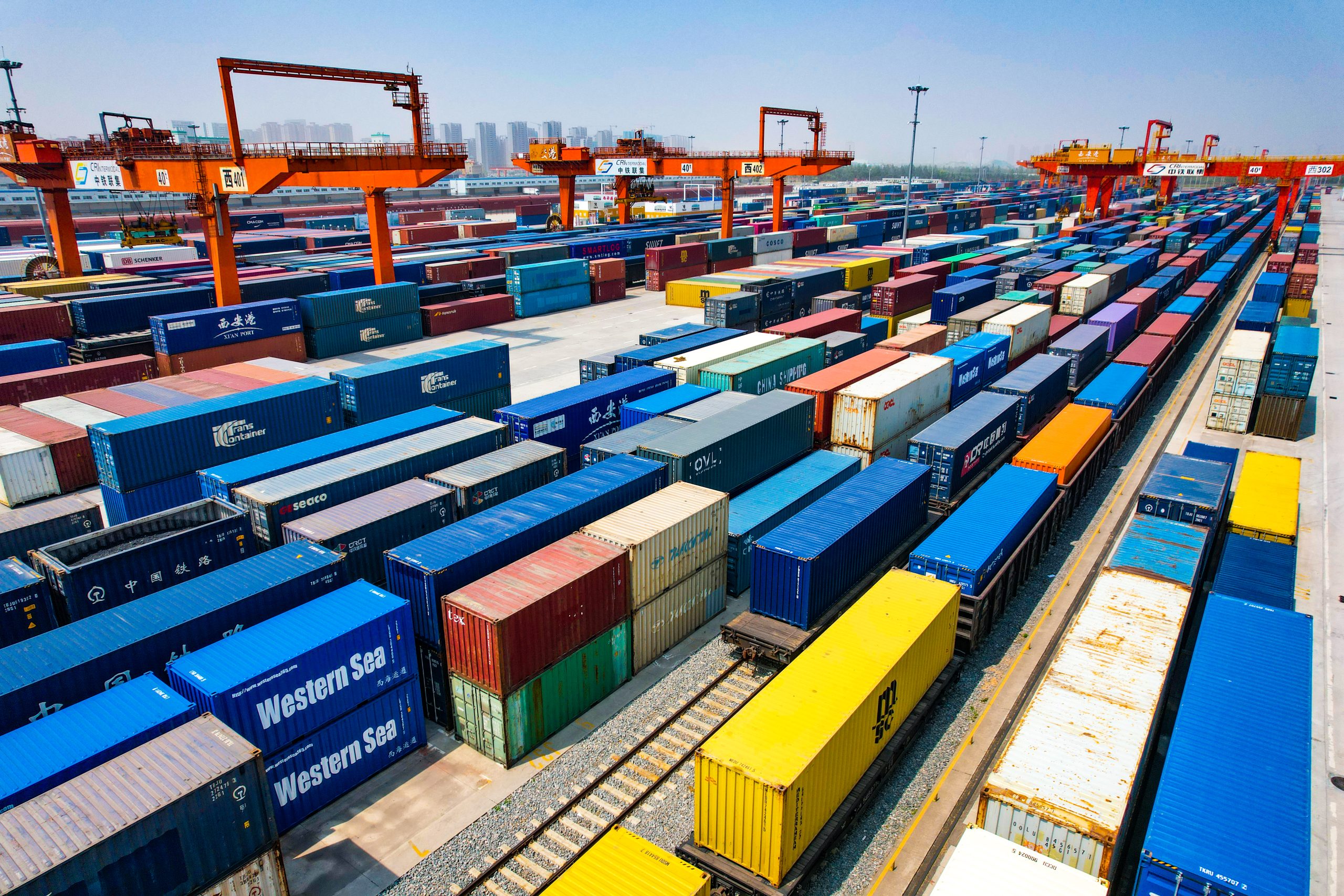
Your Container Changes Trains Twice. Your Cargo Only Gets Packed Once.
Your container leaves Xi’an on one train and reaches Tehran on another. In between sit two border crossings, two gauge changes, and at least three occasions when something heavy picks your box up and sets it back down.
Every packing decision worth making on this lane follows from that. Almost none of it appears in a quotation, and none of it can be fixed once the doors are sealed.
What actually happens at Sarakhs
Sarakhs is the rail crossing on the Iran-Turkmenistan border, in the country’s north-east corner. It is where your container changes trains for the second time, because the network it has been riding since Kazakhstan is built to 1520 mm and Iran’s network is built to 1435 mm.
A container cannot roll through that difference. It is lifted off one wagon, moved, and set onto another.
This is the part investors read as a customs story and operators read as a crane story. The crane version is closer. In September 2025 the Iranian and Turkmen railway authorities agreed to build two additional gauge-transfer tracks at Sarakhs — one standard gauge, one broad gauge — with Turkmenistan adding 200 to 300 freight wagons to feed the crossing. Capacity is being added where the queue forms, and the queue forms at the lift.
What that means for you is narrower and more practical: your cargo will be handled by people who are not your factory, using equipment you did not choose, under time pressure you cannot see. Packing is the only variable in that sentence you control.
Two gauge changes, three handlings
A westbound container to Tehran meets the gauge question twice. Once at Alashankou or Khorgos, where China’s 1435 mm network meets the 1520 mm network of Kazakhstan — the same crossing every westbound China-Europe Railway Express service uses. Again at Sarakhs, where the 1520 mm network meets Iran.
Add the loading at origin and you have three moments when the box is open, suspended or being moved, and every one of them is a chance for cargo to shift inside it.
The container almost always survives this. Steel boxes are built for it. What does not always survive is what is inside: the machine that settles against a door, the crate that leans, the pallet that loses a bottom board and takes the load above it down with it.
Damage on this lane is rarely caused by the train. Trains ride well. It is caused by the lift that precedes and follows the ride.
Load for the lift, not for the train
The instinct when packing for rail is to think about distance. That is the wrong problem. Track is smooth and the forces in normal running are modest. The forces that matter arrive in short bursts: a spreader taking up slack, a box swinging a few degrees before it settles, a twistlock engaging with the load slightly off balance.
Three consequences follow.
Fill the box. Void space is not neutral. A load that can move will move, and once it has moved it does not come back. Cargo that fills the container to the walls under light compression is safer than cargo that fits neatly with room to spare.
Keep the centre of gravity low and centred. Heavy items on the floor, distributed across the length of the box rather than clustered at one end. A container lifted off-centre loads the spreader unevenly and swings more than it needs to.
Do not use the walls as a restraint. Container side panels are thin corrugated steel. They will hold a pallet that leans on them and they will not hold a tonne of machinery that decides to slide.
Blocking and bracing, in plain terms
Blocking stops movement. Bracing transfers force into something that can take it. Both are cheap at origin and impossible at the border.
- Timber blocking against the load, fixed to the container floor, so the load cannot slide along or across the box.
- Diagonal bracing into the corner posts and the floor — the structural points — rather than into the side walls.
- Dunnage and airbags in the gaps, with the load already blocked. Airbags fill space; they do not restrain weight.
- Lashing rated to the load, not to the cargo’s appearance. Strapping holds an item in place. It does not stop a heavy item from shifting if the blocking behind it is missing.
- Nothing resting against the doors. When the doors open at Aprin, whatever is leaning on them falls out.
The test is simple and worth applying before the doors close: if the container were tilted a few degrees, what would move first? Whatever the answer is, that is the piece that needs blocking.
Density decides the box before you pack it
Two different limits end a rail loading, and which one you hit first is decided by the cargo, not the schedule.
Dense cargo — steel, machinery, tiles, bagged material — runs out of permitted weight while the container is still half empty. The packing problem there is distribution and restraint, not volume; a half-loaded heavy box needs more blocking than a full one, because there is more room to move in.
Light, bulky cargo — furniture, foam, packaging, assembled goods — runs out of space long before it runs out of weight. That is where the choice between a 20-foot and a 40-foot container, or between a full container and consolidation, actually gets made, and it gets made badly when it is made after the goods are already packed.
We quote on gross weight and volume together for exactly this reason. A booking taken on volume alone usually turns into a conversation about re-packing.
Wood packaging is a quarantine question
This is the failure that stops Iranian shipments more often than damaged cargo does, and it has nothing to do with how well anything is secured.
Iran applies ISPM 15, the international standard for wood packaging in trade. Any solid-wood packaging that carries, supports or braces your goods — pallets, crates, bearers, dunnage, bracing timber — must be treated and marked.
The acceptable treatments are heat treatment, with the wood’s core reaching 56 °C for 30 continuous minutes, or methyl bromide fumigation. The treated unit then carries the IPPC mark: the IPPC symbol, the country code, the producer’s registration number and the treatment code, sprayed or branded on. Handwritten marks are not accepted. Timber must be bark-free, and free of insect holes, mould and live pests.
Plywood, particle board, fibreboard and wood under 6 mm thick are exempt, because the manufacturing process already removes the risk. If you want to eliminate this problem entirely rather than manage it, pack in manufactured board.
Two operational points matter more than the standard itself. First, a mark that has been scuffed, over-painted or made illegible is treated as no mark at all — which means re-treatment or destruction on arrival, at the sender’s cost, with the demurrage clock running. Second, this is a document that gets checked by eye at a border, so the evidence has to exist before the container leaves: photograph every mark, and send the photos to your consignee and their broker for a look before loading. Their answer costs nothing. Discovering the problem at Aprin costs a great deal.
Marks that survive two handlings
Shipping marks are read by people who did not pack the box, in a language they may not read, after the box has been lifted twice.
Mark at least two sides, in stencil or direct print rather than on a paper label that will peel. Include the consignee’s reference, the package count and the gross weight. Keep the marks consistent with the packing list, because a discrepancy between a carton stencil and a document is exactly the kind of detail an inspection stops for.
One regional rule overrides any house style: nothing on the packaging, the branding or the paperwork may carry Israeli-linked markings. That is a red line at Iranian customs, and it has stopped containers that were otherwise flawless.
Moisture, and the cargo nobody inspects until it arrives
A container moving west through Central Asia in winter passes through repeated freeze-and-thaw, and a steel box breathes with it. Water that was in the air at loading condenses on the ceiling and drips onto the cargo. It is the least dramatic damage on this lane and the most common.
Three things help. Desiccants sized to the container’s volume rather than a token sachet per corner. Vapour-phase protection for machinery and anything with bare metal surfaces. And no wet timber inside the box — green or damp dunnage is a moisture source you paid for.
The photographs are the claim file
If cargo arrives damaged, the question that decides the claim is where the damage happened. Nobody can answer it retroactively. Somebody has to have photographed the box before it was sealed.
Six frames cover it: the empty container, floor and walls; the load half-built with blocking visible; the finished load before closing; the seal number in close-up; the doors closed with the seal in place; the container number. Timestamped, kept with the booking file.
This takes four minutes at loading. It is the difference between a claim and an argument.
What we ask before we book the slot
- What the cargo is, and its HS code
- Gross weight and total volume, measured rather than estimated
- Palletised or floor-loaded, and how the units are secured to each other
- Whether the packaging contains solid wood, and whether the marks are legible
- Which city in Iran the goods are actually going to, not just the railhead
- Who opens the container at Aprin, and whether they have equipment to handle the load as packed
The last question is the one people skip. Cargo packed for a forklift and delivered to a yard without one gets unpacked by hand, in the rain, by whoever is available.
If you want the corridor context behind these handlings, it sits in our guide to China to Iran by rail. The paperwork that travels with the box is covered separately in our notes on export documentation, and the final leg from Aprin is a road transport movement unless you have booked it through.
Let’s talk before you load
Send us the commodity, the weight and volume, and a photo of how the factory intends to pack it. We will tell you what will move on the lift at Sarakhs, whether the wood packaging will pass, and what has to change before the container is sealed rather than after.
No commitment required. Just a conversation.
Email: [email protected]
WhatsApp: https://wa.me/message/QPR7JMHO3NFZE1
Based in: Xi’an International Trade & Logistics Park
Archer Sourcing helps European, Central Asian, and Middle Eastern businesses move cargo from China via the China-Europe Railway Express and overland corridors. We operate from Xi’an — the departure hub of the Chang’an rail service.