
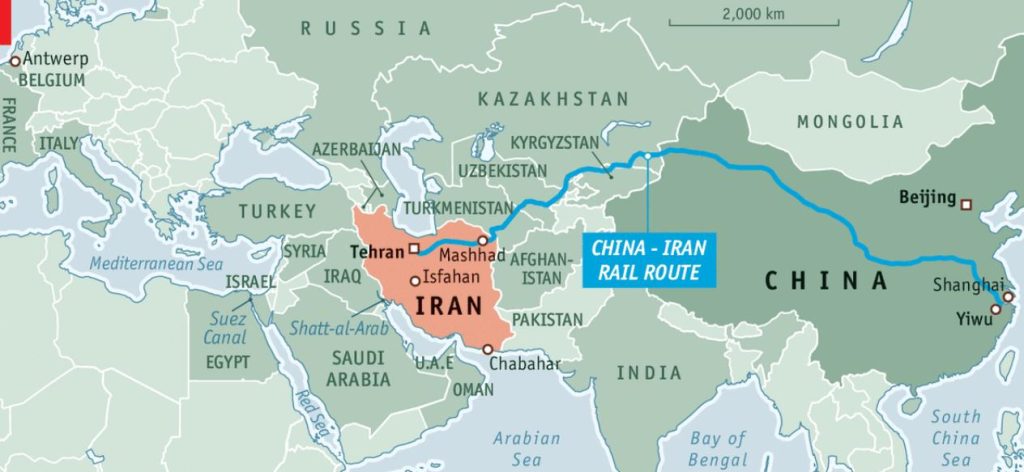
China to Iran by Rail in 2026: The Route That Doesn't Need the Strait of Hormuz
If you buy from China and ship into Iran, your sea freight quote has probably stopped being useful. Since late February the Strait of Hormuz has effectively been closed to liner traffic, carriers suspended Bandar Abbas calls, and war-risk premiums went through the roof. This is a plain-spoken guide to the corridor that actually works now — how it runs, how long it really takes, what it costs and why, and the five things most buyers get wrong.
1. What Actually Happened at Hormuz — and Why It Matters to Your Purchase Order
The picture is not ambiguous, whatever the headlines say about a "reopening":
| Fact | Status (October 2026) |
|---|---|
| Strait status | Effectively closed since 28 February 2026; Iran maintains the closure as leverage and has rejected the route maps proposed during indirect talks. |
| Maritime traffic | Detectable vessels through the strait fell to roughly seven per week in early October — the lowest since July. Before the war it handled about 125 large commercial vessels a day. |
| Security | Four tanker strikes reported between 1 and 4 October alone; drone and projectile attacks continue to be logged almost daily. |
| Shipping cost signal | Captains willing to transit are being paid around USD 100,000 base plus a USD 50,000 per-voyage bonus. That premium is the clearest read on risk available. |
| Container lines | Mainstream carriers rerouted away from the Gulf, applying Cape-routing surcharges to Gulf-bound cargo where they accept it at all. |
What this means for importers
The practical consequence is simple: for most importers, sea freight from China to Iran is currently either unbookable or priced as a gamble. Air freight works but destroys your margin on anything heavier than samples. Which leaves rail.
2. The China–Iran Rail Corridor Is No Longer Experimental
This is not a contingency route thrown together after the crisis. The Xi'an–Tehran service was launched in May 2025, built on rail agreements assembled over several years. It is part of the sixth corridor of the Belt and Road's New Silk Road Economic Belt — the China–Central Asia–West Asia Corridor.
What changed since April 2026 was volume. With the maritime blockade in place, departures from Xi'an to Tehran went from roughly one train a week to one every three or four days, capacity sold out weeks ahead, and Chinese operators went looking for additional rolling stock. Iranian factories now depend on this channel for automotive parts, generators, electronics and industrial materials.
The Routing, End to End
| Segment | Detail |
|---|---|
| Origin | Xi'an International Port (with pickup available from Shanghai, Taicang, Ningbo and other major Chinese origins). |
| Exit from China | Khorgos or Alashankou, Xinjiang. |
| Transit countries | Kazakhstan → Turkmenistan (some routings use Uzbekistan) under T1 transit — no customs clearance in the transit countries. |
| Entry into Iran | Sarakhs (northeast) or Incheh Borun — the two working border crossings. |
| Terminus | Aprin Dry Port, southwest Tehran; onward rail distribution to Mashhad, Isfahan, Tabriz, Shiraz, or truck for last mile. |
| Total distance | Approximately 10,400 km. |
| Gauge changes | Two: China standard gauge 1,435 mm → Kazakhstan/Turkmenistan broad gauge 1,520 mm → Iran standard gauge 1,435 mm. |
Everything moves under a single SMGS / CIM international rail waybill. The container is not opened or stripped at any border — a point worth stressing, because cross-border unpacking is where most damage and pilferage claims on this region come from.
3. Transit Time: Plan for 15–22 Days, Not a Marketing Number
Operators on this corridor quote 14–18 days station-to-station in normal conditions. We advise buyers to plan on 15–22 days to absorb the two variables that actually move the clock: queueing at Sarakhs during transshipment, and peaks around Chinese and Iranian holidays.
| Corridor | Routing | Typical Transit |
|---|---|---|
| North / full rail | China → Kazakhstan → Turkmenistan → Sarakhs or Incheh Borun → Aprin | 15–22 days station-to-station |
| South / rail + Caspian ferry | China → Kazakhstan → Aktau port → Caspian ferry → Anzali port | 22–25 days, and exposed to Caspian weather and ferry schedules |
| Sea (for reference) | China → Strait of Hormuz → Bandar Abbas | Effectively unavailable; not a planning basis in 2026 |
Why we lead with the north line: it removes the Caspian ferry leg entirely. No waiting on vessel schedules, no weather exposure, one continuous rail movement. The south line only makes sense if your destination is genuinely on Iran's Caspian coast.
4. Honest Pricing: Why Rail to Iran Is Not Cheap, and Won't Get Cheap Soon
Since the blockade, 40-foot container rates on this corridor have risen by roughly 40 percent against pre-war levels. Two structural reasons, neither of which is going away:
- Demand is wartime demand. Volume roughly doubled onto fixed infrastructure with finite rolling stock.
- The trains come back nearly empty. Eastbound utilisation is poor — and every empty return is cost that gets carried on your westbound rate. Anyone quoting you a pre-blockade number is either quoting from a stale sheet or hasn't costed the return leg.
| Item | Indicative | Scope Note |
|---|---|---|
| Rail freight, COC 40HQ, station-to-station | USD 10,700 | Includes container positioning from Shanghai / Taicang / Ningbo and one export customs clearance. |
| SOC / own equipment | On request | Priced separately by equipment type. |
| LCL consolidation | On request | Only consolidated at origin; do not expect LCL from every Chinese port. |
| Inland Iran delivery | Quoted per destination | Truck last mile from Aprin; Tehran same-day, other cities 1–3 days. |
Important pricing note
Treat these as indicative. Rates move with equipment availability and are confirmed per booking. A quote that stays valid for 30 days on this corridor in current conditions is a quote nobody intends to honour.
5. What Ships Well — and What Will Give You a Headache
| Ships Well | Needs Pre-Approval or Is Declined |
|---|---|
| Automotive parts and components | Dangerous goods — assessed case by case, never assumed. |
| Generators, machinery, industrial equipment | Lithium batteries and energy-storage products — declared and packed to spec, or refused. |
| Solar panels and electronics | ISC tankers (ISO tanks) — not accepted on the block train. |
| Building materials, hardware, general merchandise | Multi-commodity mixed loads — materially higher inspection probability at Sarakhs. |
| Chemicals (documented non-hazardous) | Anything without a verifiable HS code and consistent paperwork. |
Single-commodity general cargo clears fastest. This is the single most actionable piece of advice for the corridor: one clearly declared product per container, with invoice, packing list, waybill description and HS code all saying the same thing. Mixed loads are the number one cause of holds here.
6. Documentation Checklist
| Stage | Documents |
|---|---|
| China export | Commercial invoice, packing list, sales contract, customs declaration and power of attorney, CO / CCPIT certificate of origin, VGM. |
| International carriage | SMGS / CIM through waybill; T1 transit guarantee. |
| Packaging compliance | IPPC / ISPM-15 marked wood pallets; for liquids and chemicals — full 16-section MSDS plus a non-hazardous transport certificate (MSDS alone is not sufficient to book). |
| Iran import side | Consignee tax ID; ISIRI / COI conformity certificate where the product is on the mandatory list — confirm before you ship, not after. |
- Pre-book 7–10 days ahead. This is a scheduled service with sold-out capacity, not spot space.
- Weight distribution is enforced. Heavier cargos must be loaded and lashed to rail standard — keep stuffing and lashing photographs; Sarakhs inspection regularly asks for them.
- Insure for real declared value, and ask specifically whether war and riot risk extension is included.
7. Terms, Payment, and Where We Draw the Line
We work on EXW / FCA / FOB / DAP / DDU. Two things we will not do, stated up front because they are where most disputes on this lane start:
- We do not promise DDP into Iran. Anyone offering a flat "delivered duty paid, all in" number on this corridor either has a local partner you cannot verify or is absorbing a risk that will surface later as a surcharge.
- Payment is by T/T, 100% before departure for Iran-bound cargo. We do not accept cash handed to an agent at destination, and we do not release against arrival.
Archer Sourcing is a sourcing and logistics advisory practice. We coordinate the movement and paperwork with vetted rail operators and handle the China-side work directly — we are not ourselves the carrier. That is not a disclaimer; it means we can tell you without hedging which part of the chain we control and who is responsible for the rest.
Frequently Asked Questions
Can I Still Ship by Sea to Bandar Abbas?
In practice, rarely and not reliably. Major liners suspended calls, traffic through the strait is a fraction of pre-war levels, and war-risk pricing makes quoted rates volatile. We treat sea as unavailable when planning.
Is the Rail Route Itself Exposed to the Conflict?
The corridor runs through Kazakhstan and Turkmenistan and enters Iran overland in the northeast — it geographically bypasses the Strait of Hormuz and the Gulf entirely. That is the point of it.
Can You Ship from Shenzhen or Guangzhou Rather Than the North?
Yes — containers are trucked or railed to the northern consolidation point before loading. Factor a few extra days for that domestic leg.
What If My Supplier Has No Export Licence?
This is common and manageable. We can arrange export documentation through a licensed trading entity, and handle CO issuance and the linked procedures.
How Early Should I Commit?
Given capacity is selling out weeks ahead, treat 7–10 days of lead time as standard and more during Chinese holiday periods.
Planning a China → Iran Shipment?
Send us the commodity, HS code, weight and volume, pickup city and target ETD. We will tell you honestly whether rail suits this shipment, and give you a corridor-specific cost and transit picture before you commit to anything.
To help us quote accurately, please provide:
- Commodity description and HS code
- Gross weight and cargo volume
- Pickup city in China
- Container type or shipment mode (FCL / LCL)
- Destination in Iran and target ETD
Archer Sourcing
China Sourcing, Supplier Verification and Export Logistics
Email: [email protected]
Website: www.archersourcing.com
Planning note: Transit times, routing, border procedures, cargo acceptance, documentation requirements and freight rates are subject to confirmation by the relevant rail operators, customs authorities and destination-side partners. Confirm current operating conditions and applicable import requirements before booking.