
EXW vs FCA vs FOB vs DAP: Choosing Terms When Buying from China
The price is only comparable once the term matches
Two quotes arrive for the same machine, from the same factory, leaving the same province. One is lower. The gap is not the freight rate — it is the point at which the seller stops being responsible.
An Incoterm does three jobs at the same time. It splits cost, it splits risk, and it decides who is allowed to speak to customs. Change the term and you have changed the product you are buying, even though the goods on the pallet are identical.
We read Chinese supplier quotations every week. The most expensive mistake we see is not a wrong price. It is a correct price attached to the wrong term.
What an Incoterm allocates, and what it does not
Three columns matter: who pays, who carries the risk at each stage, and who files the export and import declarations.
What Incoterms do not cover is just as important. They say nothing about when ownership of the goods passes, nothing about payment terms, nothing about quality or warranty, and nothing about sanctions or import licensing. Those belong in the contract, not in a three-letter abbreviation.
| Term | Seller’s responsibility ends | Export clearance | Main carriage | Import clearance | Modes |
|---|---|---|---|---|---|
| EXW | Goods ready at the seller’s premises, not loaded | Buyer | Buyer | Buyer | Any |
| FCA | Cleared for export, handed to the buyer’s carrier | Seller | Buyer | Buyer | Any |
| FOB | Loaded on board the vessel | Seller | Buyer | Buyer | Sea and inland waterway only |
| CPT | Handed to the first carrier, freight paid to the named place | Seller | Seller | Buyer | Any |
| DAP | Arrived at the named place, ready for unloading | Seller | Seller | Buyer | Any |
| DDP | Arrived, import cleared, duty paid | Seller | Seller | Seller | Any |
The four terms that cover most China purchases
EXW: the cheapest quote that usually is not
EXW puts everything on the buyer from the factory gate. The seller does not load the truck, does not declare the export, and does not appear as the exporter of record.
In China that has a consequence most buyers do not see on the quotation. A supplier selling EXW normally does not export in its own name, so it cannot claim the export VAT refund on that shipment. Suppliers who understand this price the difference back in, which is why an EXW quote is often not cheaper once the whole chain is added up. The loading is yours too, and a loose load on a factory ramp is a damage claim waiting to happen.
We rarely recommend EXW for a first order.
FCA: the term that fixes the export problem
FCA means the seller clears the goods for export and hands them to the carrier you nominate. If the named place is the seller’s premises, the seller loads. If it is a terminal, the seller delivers there and the loading is arranged at the terminal.
Two details decide whether FCA works in practice.
The named place has to be a real place. “FCA Ningbo” is a city, not a delivery point, and it will be argued about later. Write the address or the terminal.
And under Incoterms 2020, where a letter of credit requires an on-board bill of lading, the buyer must instruct the carrier to issue that document to the seller. Without the instruction, the seller cannot present the paperwork the bank is asking for, and the payment sits still while everyone blames the forwarder.
FOB: port to port, and nothing beyond it
FOB is the most quoted term in Chinese export and the most misused one. Risk passes when the goods are on board the vessel at the named port of shipment, and it applies to sea and inland waterway carriage only. FOB has no meaning on a train.
The container problem is structural. A container is handed to the terminal well before the vessel sails. Between handover and loading, the seller has lost physical control of the cargo but still carries the risk of it. That gap is why FCA fits containerised cargo better than FOB, and why the two are so often quoted interchangeably when they are not.
DAP: delivered, not cleared
DAP means the seller delivers to the named place with the goods ready for unloading, while import clearance and duty stay with the buyer. It is the practical replacement for the term everyone still says out loud.
What DAP does not include is the unloading itself. If the truck arrives and nobody at the delivery point can take the pallets off, that is a cost and a delay the buyer owns, and it usually surfaces as a complaint about the freight.
DDP: the seller becomes the importer
DDP means the seller clears import and pays the duty. In some markets that is simply not available to them: no VAT registration, no ability to act as importer of record, no standing to be the declarant. A DDP quote that looks convenient can stall at the border for reasons that have nothing to do with the cargo.
And DDU is gone. It was removed after Incoterms 2000 and does not exist in Incoterms 2020. A supplier still quoting DDU is quoting a term with no published rule set, which means every obligation inside it is whatever the two of you agreed — or failed to.
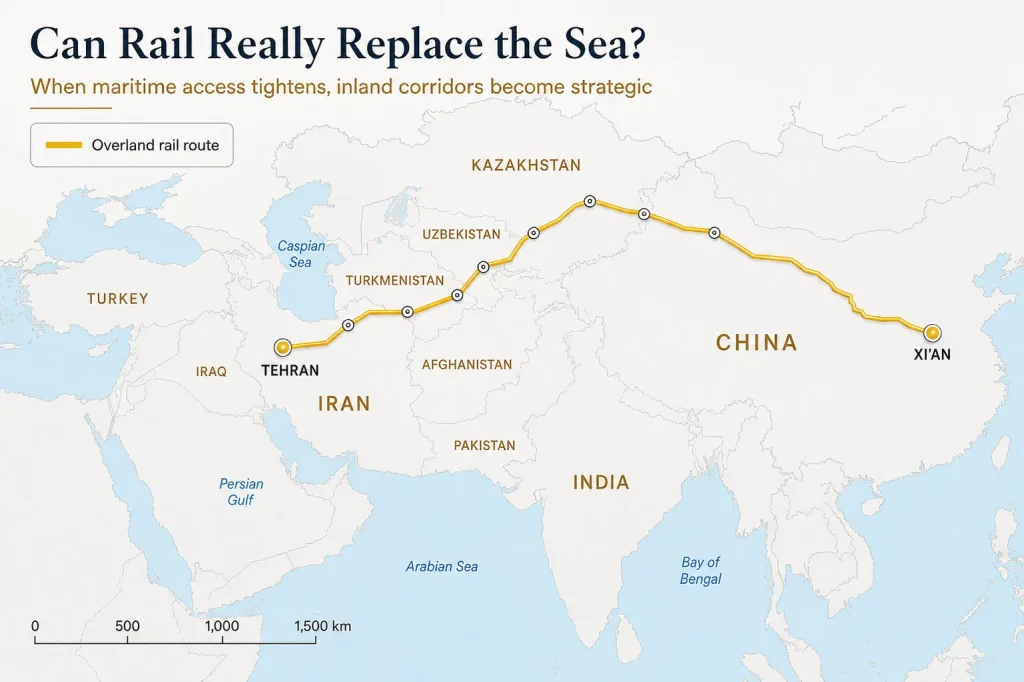
The rail problem: FOB does not travel by train
Incoterms were written around ships. Of the eleven rules, four apply only to sea and inland waterway carriage. The rest work on any mode.
For rail and multimodal transport, and for the China-Europe Railway Express in particular, the useful set is FCA, CPT, CIP and DAP. Buyers who paste FOB onto a rail booking are describing a handover that does not exist on a train.
CPT and CIP carry a detail that catches people. Risk passes when the goods are handed to the first carrier, not when they arrive at the destination. If a container is damaged somewhere between Xi’an and the Polish border, the buyer has owned that risk since the moment it left the terminal, even though the seller paid the freight all the way through.
Insurance changed in the same direction. Under Incoterms 2020, CIP requires all-risks cover under the Institute Cargo Clauses (A), while CIF still requires the minimum (C). For high-value machinery, that difference is the entire reason to choose CIP.
Where buyers get it wrong
- FOB on a rail booking. The term only exists for water carriage.
- EXW assumed to include loading. It does not, and the loading crew is then arranged by whoever is at the gate.
- DDU in a new contract. The term was withdrawn; a contract that names it has no default rules.
- DAP assumed to include unloading. It does not — DPU is the rule where the seller unloads.
- CIF assumed to mean full cover. It is the minimum cover, not the widest.
- A named place that is a city. “FCA China” cannot be performed or disputed properly.
A short decision rule
- Full container, you control the freight: FCA at the seller’s premises or at the terminal.
- LCL or groupage: CPT or CIP to the destination terminal, with the named place written precisely.
- You want the door and you can clear import: DAP.
- You want to hand over everything including duty: DDP, after confirming the seller can legally be the importer in your country.
- Conventional sea freight loaded at the berth: FOB still works.
- Never: EXW on a first order, and DDU at any time.
The document that carries the term
The term has to appear on the commercial invoice, and it has to match the transport document, the packing list and the export documentation. An invoice that says FCA against a bill of lading that says FOB is a customs question, and it usually arrives when the cargo is already standing at the border.
Write the term with its version and its place: FCA Xi’an, Incoterms 2020. Without the year, an old contract template quietly imports the old rule set, and the difference is discovered by the person who has to pay for it.
Let’s Talk Terms Before You Book
If you are comparing quotations from two Chinese suppliers and the numbers do not line up, send us both. We will tell you what each term actually includes, where the risk sits at each stage, and which one we would put on the booking.
No commitment required. Just a conversation.
Email: [email protected]
WhatsApp: https://wa.me/message/QPR7JMHO3NFZE1
Based in: Xi’an International Trade & Logistics Park
Archer Sourcing helps European, Central Asian, and Middle Eastern businesses move cargo from China via the China-Europe Railway Express and overland corridors. We operate from Xi’an — the departure hub of the Chang’an rail service.