
Five Ways Cargo Reaches Iran, and What Moved This Quarter
The question stopped being about price
For most of this decade, routing cargo to Iran was a price exercise. You compared ocean rates to Bandar Abbas, picked the cheapest sailing, and treated everything else as a backup plan.
That exercise no longer works. Since February 2026 the sea door has been shut, and what is left is five real ways in. They are not interchangeable, they do not compete on the same number, and the right one depends on where your consignee actually is and whether anyone owns the container.
Here is each door, what it costs, and what changed in the last four weeks.
Door one: rail all the way to Tehran
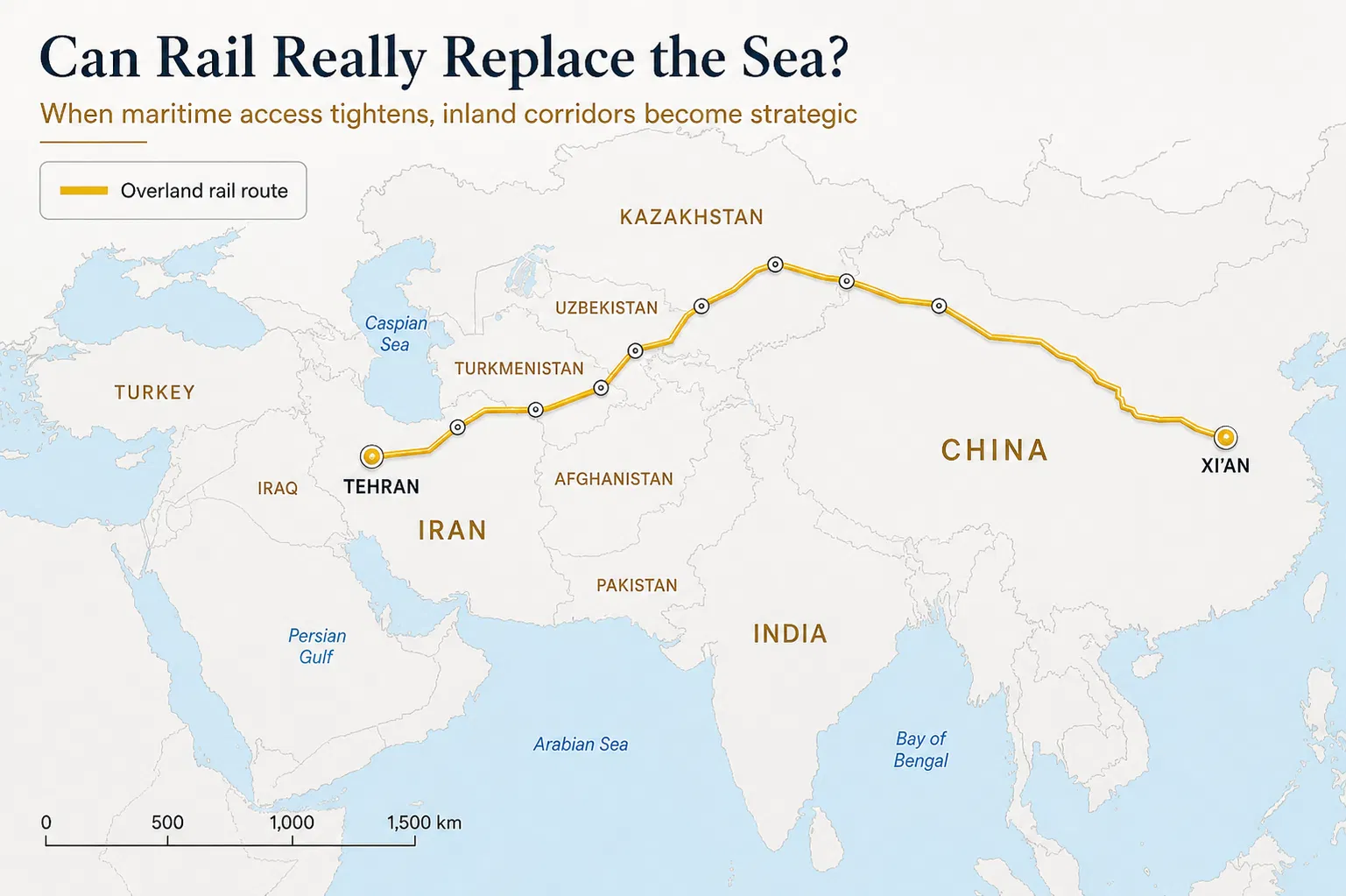
The working corridor runs from a Chinese inland hub through Khorgos to Bolashak in Kazakhstan, enters Iran at Sarakhs or Incheh Borun, and terminates at Aprin Dry Port in Tehran. This is the route we cover in detail under rail freight from China to Iran.
Transit is station-to-station and runs about 15–22 days, moving with the border queue at those two crossings rather than with the train timetable. Five origins load this lane: Xi’an, Chengdu, Hefei, Zhengzhou, and Wuhan.
On the November 40HQ card, Xi’an quotes USD 11,780, Zhengzhou USD 12,380, Chengdu USD 12,400, and Hefei USD 13,550. Wuhan is the outlier at USD 9,700, on a shipper-owned container and restricted to Hubei-origin cargo. Carrier-owned bookings require 70% on booking to hold the slot, with the balance cleared before departure, and the Xi’an departure carries 60 days of free container use.
This is the default when your consignee is in Tehran and can receive a full container.
Door two: rail to the border, road for the last leg
The same train can stop at the border instead of the dry port. From Sarakhs, road delivery into Tehran runs USD 860 per container, quoted against the actual shipment rather than the card.
Splitting the journey at the border makes sense when the consignee sits outside Tehran, or when you would rather not depend on the rail leg clearing into Aprin on a specific day. What you give up is the single box moving under one document to the door.
Read the Sarakhs numbers carefully, because they are not like for like. Chengdu quotes USD 7,500, or USD 7,600 with destination ground handling and clearance included. Zhengzhou quotes USD 8,830 and excludes both. Xi’an quotes USD 7,790 on the weekly public train, and USD 10,500 on fixed-date departures that include one customs declaration. Four different products, four different numbers.
Door three: Trans-Caspian, which is really a Caucasus route
If the destination is Georgia or Armenia rather than Iran, the routing changes entirely. Chengdu loads to Poti at USD 4,400 and Tbilisi at USD 4,500 on 19 and 30 November. Xi’an runs to both every Friday at USD 4,800, with a cargo ceiling of 23 tonnes per 40ft.
This is not a Tehran workaround. It lands on the other side of the Caucasus, and from there the cargo moves by road. Anzali has no direct block train, and northern Iranian ports are assessed per shipment rather than promised in advance.
If the Caucasus is your market, the corridor logic is covered in our notes on the Middle Corridor.
Door four: the sea, and why it stopped being the default
The Strait of Hormuz has been disrupted since February 2026. Maersk, MSC, CMA CGM, and COSCO have suspended direct calls to Bandar Abbas, and the port is operating at severely reduced capacity. A firm booking to Bandar Abbas through Khorfakkan is currently not available from main-line carriers.
Where space can still be found, the carrier applies a war risk surcharge of roughly USD 1,500–4,000 per container, on top of base ocean freight of USD 2,300–2,900 for a 20’GP and USD 4,400–5,500 for a 40’HC. Transit runs 18–25 days when the lane is functioning at all, and the number moves week to week.
The honest framing is that this is not a cheaper option with a delay attached. It is a different risk, priced on a weekly basis, with availability that nobody can confirm in advance.
Door five: TIR road, and the loads it wins
Road moves daily from the Urumqi side, through Lotfabad, into Tehran, at USD 17,100 per truck. That figure includes one transit customs fee and border handling, with delivery free within 20 km of Tehran, and excludes lashing and insurance.
The constraint is payload: roughly 20 to 22 tonnes per truck. Road wins on dense, high-value cargo and on urgency, and loses on cost per tonne the moment the volume justifies a container.
What moved this quarter
Prices moved less than the packages around them did. Five things are worth knowing before you compare a quote from last month with one from this month.
The scope changed before the number did. Our late-October card quoted Tehran rates including destination ground handling and one export clearance. November rates are station-to-station into Aprin Dry Port with one export declaration, and destination handling is now a separate line on several lanes. A lower number this month can simply be a smaller package. Ask what is inside the rate before you rank it.
SOC is disappearing from the Tehran lane. Zhengzhou’s shipper-owned quote has been withdrawn and only carrier-owned is offered now. Wuhan’s low number is SOC and restricted to Hubei-origin cargo. The two structures are not interchangeable, and the cheaper one is getting harder to book.
Cash moved forward. A 70% prepayment on booking is now standard on Tehran carrier-owned rates, with the balance cleared before departure. Space is being held by money rather than by intent, which matters if your own cash cycle assumes payment against shipping documents.
Free time became the product. The Xi’an booking carries 60 days of container use. A 40HC cargo-worthy lease costs USD 2,800 per container with 90 days free, then USD 10 per day, collectable at ten Chinese ports at the same price. On this lane, free days are worth more than a small difference in the headline rate.
The top of the range is holding. Hefei is the most expensive of the five Tehran origins at USD 13,550, and the platform raised it rather than discounting to fill the train. When the dearest quote stops coming down, capacity is not loose.
Two smaller notes: LCL from Xi’an to Tehran is now USD 263 per CBM plus USD 150 per bill of lading, up from USD 243 on our previous card, and booking lead time is 7–10 days ahead of departure, first come first served.
How we would choose for your cargo
- Consignee in Tehran, standard industrial cargo, no container of your own. Rail to Aprin, carrier-owned.
- You own or can lease a box, and the number matters. Rail to Sarakhs on SOC, then road.
- Consignee outside Tehran. Rail to Sarakhs plus road at USD 860 per container, priced together rather than separately.
- Dense cargo near or above 23 tonnes. Check the weight ceiling before you compare rates, because the Caucasus lane caps there and payload decides the mode.
- Under 15 CBM. LCL at USD 263 per CBM plus USD 150 per bill of lading, rather than paying for air in a box.
- Georgia or Armenia, not Iran. Trans-Caspian, not Tehran.
- A buyer who insists on Bandar Abbas. We will check live feeder space and tell you what it costs, but we will not promise a sailing we cannot confirm.
Talk to us about Iran
Tell us the destination city in Iran, the commodity, the total weight, and the date you want to ship. We will come back with the departures that actually exist for your cargo, which door each one uses, and the conditions attached to each.
No commitment required.
Email: [email protected]
WhatsApp: https://wa.me/message/QPR7JMHO3NFZE1
Based in: Xi’an International Trade & Logistics Park
Archer Sourcing helps European, Central Asian, and Middle Eastern businesses move cargo from China via the China-Europe Railway and overland corridors. We operate from Xi’an — the departure hub of the Chang’an rail service.