
China to Iran by Rail: What Is Actually Moving in November 2026
The sea door is still shut
The Strait of Hormuz remains closed, and Bandar Abbas has not resumed container calls. For anyone shipping into Iran this quarter, that single sentence decides the routing.
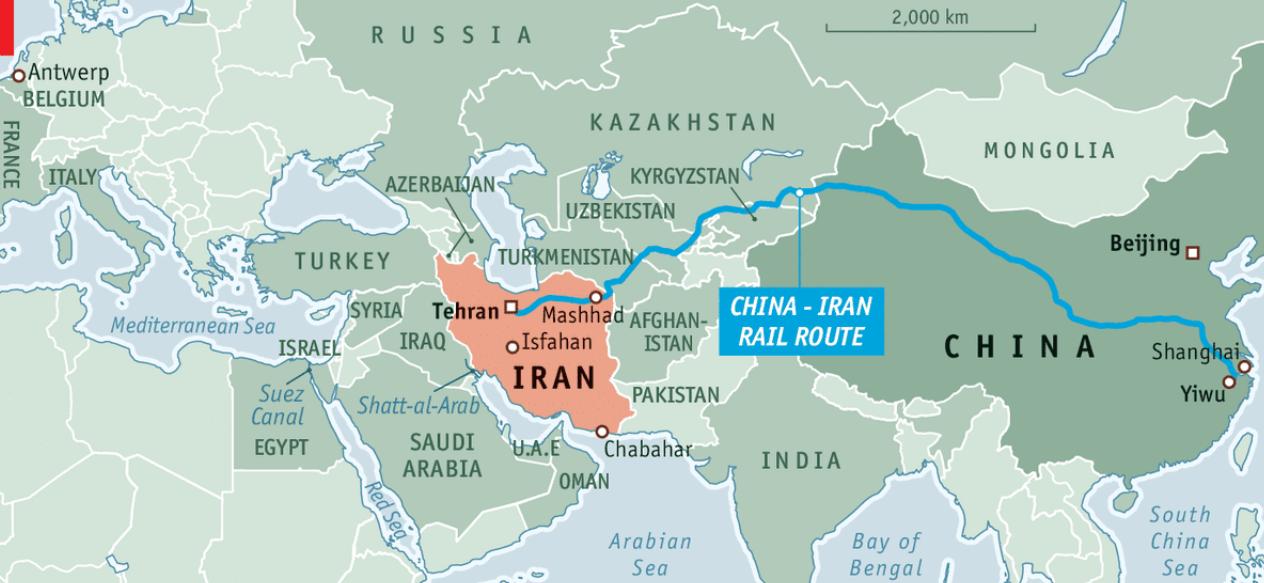
What still moves is rail: inbound through Sarakhs or Incheh Borun, terminating at Aprin dry port in Tehran. That is the channel that actually carries cargo right now, and in November the question is not whether it works — it is which origin station has capacity and at what level.
If you are new to this lane, our earlier guide on China to Iran by rail explains the corridor itself. This piece is the monthly update: departures, rates, and the conditions attached to them.
We work this corridor from five Chinese origin stations: Xi’an, Chengdu, Hefei, Zhengzhou, and Wuhan. Below are the November departures and the reference rates we are quoting, followed by what they do and do not include.
November departures to Tehran
All rates are per 40HQ, station to station, terminating at Aprin dry port, and include one export declaration.
| Route | Type | Pick-up | Departure | USD | Conditions |
|---|---|---|---|---|---|
| Wuhan → Tehran | SOC | — | around Nov 18 | 9,700 | Hubei cargo only; includes destination handling, one declaration, park detour |
| Xi’an → Tehran | COC | Qingdao / Changzhou | Nov 22 | 11,780 | 70% prepaid to lock the slot; 60 days free container use |
| Zhengzhou → Tehran | COC | Qingdao | Nov 25 | 12,380 | 70% prepaid to lock the slot; the earlier SOC offer has been withdrawn |
| Chengdu → Tehran | COC | Qingdao | Nov 10 | 12,400 | 70% prepaid to lock the slot |
| Hefei → Tehran | COC | — | Nov 5 | 13,550 | Held at this level after the increase from 12,550 |
Two things in that table are worth pausing on.
The Xi’an COC departure on November 22 includes 60 days of free container use. For most Iran-bound cargo that covers inland delivery and unloading without the clock starting too early — which is where detention charges usually appear.
The Wuhan SOC departure is the cheapest line on the page, but it is restricted to Hubei-origin cargo and is priced with destination handling and the park detour included. If your supplier is not in Hubei, that number is not available to you, and treating it as a general market rate will lead to a wrong budget.
On COC bookings, 70% is prepaid to lock the slot and the balance must be settled before departure. That is not a negotiation position; it is how the platform releases the box.
Sarakhs, the Caucasus, LCL, and the last mile
Not every shipment terminates in Tehran. Sarakhs is the border point, and for some buyers it is the right commercial destination.
| Route / service | Mode | Departure | USD | Notes |
|---|---|---|---|---|
| Chengdu → Sarakhs | SOC | 11/10, 11/24 | 7,500 / 7,600 | 7,500 on both dates; 7,600 on 11/24 includes handling and declaration |
| Xi’an → Sarakhs | SOC | weekly / 11/7, 11/10, 11/15, 11/25 | 7,790 / 10,500 | 7,790 on the public weekly service; 10,500 for the fixed slot with one declaration |
| Zhengzhou → Sarakhs | SOC | late November | 8,830 | Excludes destination handling and declaration |
| Chengdu → Poti / Tbilisi | SOC | 11/19, 11/30 | 4,400 / 4,500 | Trans-Caspian International Transport Route (TITR), Georgia direction |
| Xi’an → Poti / Tbilisi | SOC | every Friday | 4,800 | Weight cap 23 tonnes per 40ft |
| Sarakhs → Tehran | Road | per shipment | 860 / CTNR | Per container, quoted per shipment |
| Xi’an → Tehran | LCL | 11/15 | 263 / CBM | Plus 150 USD per bill of lading |
| 40HC rental box | Container rental | any time | 2,800 / CTNR | 90 days free, then 10 USD per day; same price at ten Chinese ports |
Two entries deserve a warning rather than a recommendation.
The two Xi’an–Sarakhs prices are not the same product. 7,790 is the public weekly service; 10,500 buys a fixed departure with one declaration included. If you compare them as if they were the same booking, you will pick the wrong one.
Anzali has no direct block train. If your cargo is destined for northern Iran, a Trans-Caspian routing through a northern Iranian port may work, but we evaluate it shipment by shipment and will not promise it in advance. Anyone quoting you a firm Anzali rail rate is quoting something that does not exist this month.
Two crossings, one border
Sarakhs and Incheh Borun sit on the same Turkmenistan–Iran border, and both feed the Iranian network toward Tehran. They are not interchangeable in practice.
Sarakhs is the busier of the two and the one most departures are built around. Incheh Borun is the alternate used when the Sarakhs side backs up — which is why a route sheet naming both is usually telling you something about congestion rather than giving you a choice.
For your booking, the difference shows up in two places: which departure dates remain open, and whether the destination handling is bundled into the rate. A cheaper line that leaves the border handling to you is not cheaper once that handling is invoiced.
SOC or COC: the number that is not on the rate line
The rate table hides a real decision. COC means the box comes from the carrier’s pool — in these lanes, picked up at Qingdao or Changzhou — and it comes with a 70% prepayment requirement to lock the slot.
SOC means you supply the box, and if you do not own one, you rent: 2,800 per 40HC with 90 days free, then 10 USD per day. Renting also lets you pick up at ten Chinese ports at the same price, which matters if your suppliers are scattered.
Two practical consequences. First, the COC quotes look simpler but commit your cash earlier. Second, the 60 days of free container use on the Xi’an COC departure is worth more than it sounds — it is the difference between returning the box before detention starts and arguing about it afterwards.
What you are actually buying
The rates above are platform levels, and platform levels move. They are a reference for budgeting and for comparing origins, not a contract — the binding number is the one confirmed against your actual cargo and departure.
Where the operational knowledge matters is before the rate is even quoted:
- Boxing at origin. Loading a 40HQ to the weight limit without damaging packaging is a different job at each station, and the practice differs between Xi’an, Zhengzhou, and Chengdu.
- Pick-up points. On COC bookings the box comes from Qingdao or Changzhou. That changes your inland cost, and it is invisible if you only compare the headline rate.
- Weight ceilings. The Xi’an–Caucasus service caps at 23 tonnes per 40ft. Dense cargo — machinery parts, tiles, steel fittings — hits that ceiling before it fills the box.
- Consolidation across provinces. If your suppliers sit in three different provinces, you do not need to truck everything to one station. Rental 40HC boxes can be picked up at ten Chinese ports at the same price, which usually beats inland repositioning.
If your supplier is outside the five origin cities, we arrange feeder transport to the nearest station rather than asking you to consolidate first.
What we need to quote you properly
Four things: origin city, commodity, total weight, and the date you want to ship. With those we reply with a formal quotation within 24 hours, including the conditions that apply to your specific booking rather than a headline number.
If you are also weighing risk on the supplier side before you commit to a departure, that belongs in the same conversation — see our notes on China supply chain risk management.
Ready to Run the Numbers?
Tell us the origin, the commodity, the weight, and when you want to ship. We will come back with the actual departure options for your cargo, the pick-up point, and the terms attached to each.
No commitment required. Just a conversation.
Email: [email protected]
WhatsApp: https://wa.me/message/QPR7JMHO3NFZE1
Based in: Xi’an International Trade & Logistics Park
Archer Sourcing helps European, Central Asian, and Middle Eastern businesses move cargo from China via the China-Europe Railway and overland corridors. We operate from Xi’an — the departure hub of the Chang’an rail service.