
GLOBAL TRADE CORRIDORS
China to Iran: Four Corridors and the Compliance Behind Them
Four ways to move cargo from China to Iran, what each one really takes in transit, and the four checks that decide whether a container clears the border or sits at it.
Who This Corridor Is For
Four shipping modes exist between China and Iran. None is best in general. Each is best for a specific cargo, a specific deadline, and a specific consignee.
Industrial and project importers
Heavy machinery, raw materials, steel components and auto parts, where one mismatched invoice line is enough to stop a container at the border.
Buyers who cannot wait for a vessel
When Hormuz risk and blank sailings add weeks of uncertainty, the overland corridors through Kazakhstan and Turkmenistan are the ones that still run.
Exporters who need clean paperwork
Civilian goods that need HS code validation, conformity certification, and an itemised split between carrier cost and coordination fee.
Four Ways Cargo Reaches Iran
Transit ranges below are what we quote from Chinese platforms and carriers. They move with border queues and vessel schedules, not with the calendar.
Sea freight
Loaded at Tianjin, Shanghai, Ningbo or Shenzhen and discharged at Bandar Abbas, occasionally Bandar Imam Khomeini. 25–35 days, the lowest cost per tonne, and the mode most exposed to the Strait of Hormuz. Storage at the port is limited, and demurrage climbs quickly once clearance slips.
TIR road
Out through Khorgos or Wuqia, across Central Asia and Turkmenistan, into Iran at Sarakhs, then to Tehran or Mashhad. 18–25 days door to door. The most flexible option for oversized pieces and destinations off the rail line.
Rail
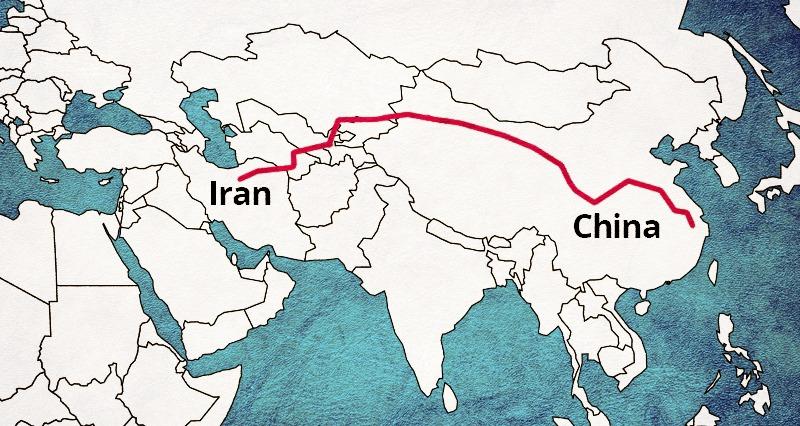
The block train through Kazakhstan and Turkmenistan to Tehran: 15–22 days station to station, 18–22 days door to door. Avoids the strait entirely, takes both full containers and LCL, and balances transit against cost better than either sea or air.
Air
Direct to Tehran IKA in 1–7 days. Kept for urgent spares, samples and high-value small consignments. Batteries and precision instruments need MSDS and UN38.3 papers before any carrier will accept them.
Choosing Between Them
The table is a starting point, not a quotation. Weight density and the consignee’s city usually decide more than the headline transit time.
| Mode | Gateways | Transit | Best for |
|---|---|---|---|
| Sea | Tianjin / Shanghai / Ningbo / Shenzhen → Bandar Abbas | 25–35 days | Building materials, large machinery, cost-sensitive volume |
| TIR road | Khorgos / Wuqia → Central Asia → Sarakhs → Tehran, Mashhad | 18–25 days | Project cargo, oversized pieces, remote destinations, door delivery |
| Rail | Xi’an and other hubs → Kazakhstan → Turkmenistan → Tehran | 15–22 days | Machinery, auto parts, industrial consumer goods |
| Air | Direct to Tehran IKA | 1–7 days | Urgent spares, samples, high-value small shipments |
The line the table cannot show
The Strait of Hormuz disruption that began in February 2026 stopped direct container calls at Bandar Abbas. Where space exists at all it moves through a transshipment port, and carriers add a war risk surcharge of roughly USD 1,500–4,000 per container on top of the ocean rate. Sea remains the cheapest structure for bulk ocean freight. It is no longer the predictable one, and any quotation that ignores the surcharge is not a real number.
How a Rail Booking Actually Runs
Rail is the corridor we operate most often, so it is worth showing the sequence. Most of what goes wrong on this lane goes wrong in these five steps, not on the train itself.
- Space against a departure window. Platform space is held for a specific departure, and on carrier-owned equipment a deposit is required to secure the slot.
- Container pickup. On carrier-owned bookings the box is collected from a coastal depot and moved inland before your cargo reaches it. That cost sits outside the rail rate and is invisible if you only compare headline numbers.
- Loading and sealing. Loading, seal number and interchange record happen at the origin station. This is the last moment where existing damage can be attributed correctly.
- Border transshipment. At Sarakhs the wagon gauge changes, which is why the queue there matters more than the timetable. Incheh Borun is the alternative crossing when Sarakhs backs up.
- Arrival and the Iranian leg. The train terminates at Aprin Dry Port outside Tehran. The final delivery is a separate road movement unless you booked it through.
Where Iran Shipments Actually Fail
Four checks decide the outcome long before anything is loaded. Every one of them is cheaper to fix in China than at the border.
Documents must agree with each other
Commercial invoice in Chinese and English, packing list, CMR road waybill and certificate of origin, with the same value, HS code, description and consignee on every page. Machinery and appliances need ISIRI, VOC or COI conformity certification arranged in advance. Food, pharmaceuticals and cosmetics need an Iranian import licence. TIR moves need a TIR carnet and transit permits. Markings linked to Israel on packaging, branding or documents are an absolute red line at Iranian customs.
Dual-use items need the licence first
Equipment and precision instruments under dual-use control require an export licence from the Chinese side before customs accepts the declaration, together with an end-user and end-use statement from the Iranian buyer. No forwarder can produce this after the fact, and no schedule survives trying.
Settlement has to be planned before production
USD clearing is not a practical channel for this trade. RMB settlement through the designated bank channel is the working option, and any third-party payment needs complete authorisation documents so that money, cargo and paperwork all point at the same transaction.
Clearance and insurance belong to the route
Iranian customs inspects closely, so documents should be pre-reviewed and clearance time built into the schedule. Road moves cross several countries and need cargo insurance covering the whole journey, not just the Chinese leg. Verify the consignee's tax registration before booking: an importer without a valid tax ID cannot clear the goods, and no amount of paperwork on the Chinese side fixes that.
The Friday problem
Friday is the weekend in Iran and customs does not work. A departure that lands on a Thursday can wait until Sunday for a single stamp. Put that buffer into the delivery date you promise, rather than discovering it at the terminal with a demurrage clock running.
What We Ask Before We Quote
- The commodity and its HS code, and whether it appears on any control list
- Gross weight and volume, because weight density decides between rail, road and sea
- The destination city in Iran, not just the port
- The date you actually need the goods, and the date you would accept
- Who clears the goods at the Iranian end, and whether they hold a valid import registration
If you want the routing detail behind the rail option, it sits in our China to Iran rail guide. If your cargo is heading further west than Tehran, the overland logic changes and the Middle Corridor notes explain why.
Talk to Us About Your Iran Shipment
Send the commodity, the HS code, the destination city and the volume. We will check the cargo against the control lists, outline the corridor that fits it, and itemise carrier cost separately from our coordination fee.
Archer Sourcing helps European, Central Asian, and Middle Eastern businesses move cargo from China We operate from Xi’an, the departure hub of the Chang’an rail service.