
The Warehouse Between Your Factory and Your Container
Not all of the waiting is the same
Between the factory gate and the container being loaded there is usually a gap of days. Buyers tend to treat that gap as dead time — the goods exist, the booking exists, and nothing meaningful happens until the container is full.
That is not quite right. A good share of that gap happens inside a customs-supervised warehouse: a facility licensed by Chinese customs to hold import and export cargo, and to hold goods whose customs procedures are not yet complete. It is a legal space that is neither the domestic market nor outside the customs territory, and what is permitted inside it is what decides how late in the process you can still change your mind.
What the warehouse actually is
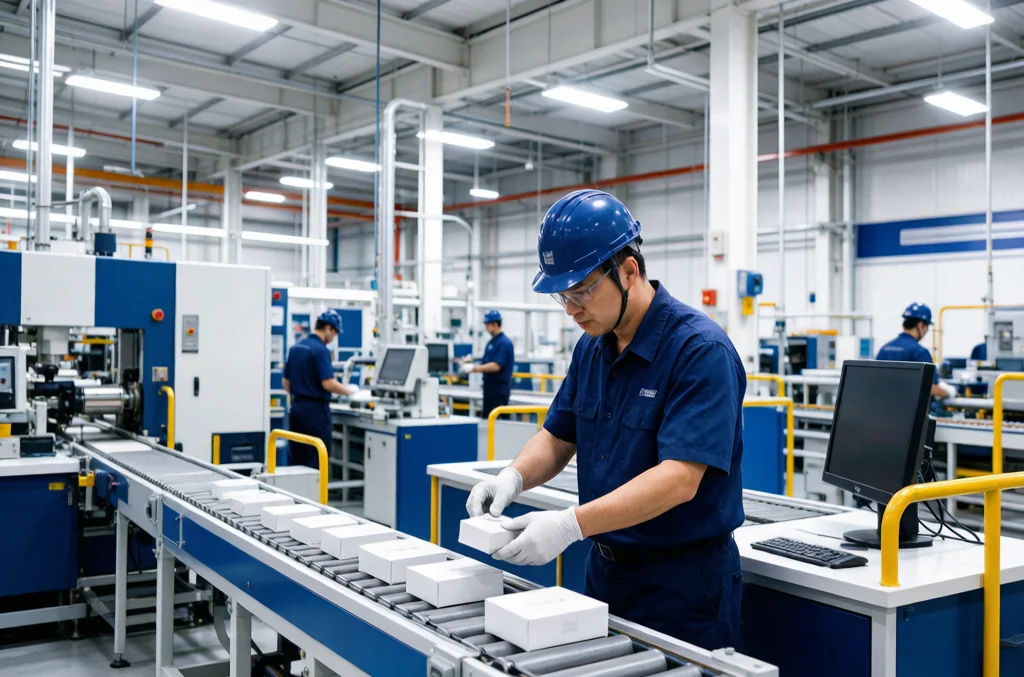
A customs-supervised warehouse is approved by customs and operates under direct customs supervision. It stores import and export goods, goods in transit and transshipment, and goods whose clearance is unfinished — including bonded cargo.
Customs may run such a facility itself, but in practice it is usually operated by a licensed warehousing company while customs retains the regulatory role. Entry into the business is not casual: an applicant needs warehousing in its business scope, facilities that meet customs requirements including safety and fire provisions, a working management system, and a credible operating record.
Physically, these sit where the movement is — at ports, at major rail terminals, and in the industrial clusters where processing trade is concentrated. That placement is not an accident; it is what makes supervision and turnover compatible.
Why consolidation happens there rather than at the factory
The single most useful thing about these facilities, from a buyer’s point of view, is that consolidation is a licensed activity inside them rather than something improvised in a yard.
Three suppliers in three provinces, each with a partial load, become one container because the cargo can be brought into a supervised warehouse, held, and loaded together. The same applies to smaller frequent batches: rather than declaring each one separately, goods can accumulate and be declared together within a defined period.
This is the mechanism behind a lot of what gets promised to buyers late in the process — “we can still add the fourth factory’s goods” is only true if there is a place where those goods can legally sit and be combined.
What else can happen under supervision
Beyond consolidation, supervised warehouses are permitted to provide value-added work: sorting and distribution, grading and classification, and changing packaging. All of it performed under customs oversight, which is the point — the work is allowed precisely because it is visible.
For a buyer this changes the timing of decisions. Market-specific packaging, re-labelling, or separating a mixed batch by grade can be done after the goods exist rather than specified months earlier at the factory. That is a real option, and it is one most buyers never ask about because they assume the only place to touch the goods is where they were made.
Where the money moves
Two financial effects are worth understanding, because both eventually reach your quotation.
Bonded storage defers duty. Goods can be held without duty being paid immediately, until they are exported onward or enter domestic circulation. For the party financing the inventory, that is working capital not tied up — and working capital has a price.
Some export warehouses accelerate the rebate. For qualifying export supervised warehouses, the export tax rebate can be processed once goods enter the warehouse rather than waiting for the full cycle. That affects your supplier’s cash position directly. A supplier whose rebate arrives sooner can quote differently from one whose money is locked for weeks, and you will never see the reason on the rate sheet.
Note the qualifier: qualifying warehouses. It is not a blanket rule, and a supplier who claims it for every shipment is worth a second question.
What cannot go in
This is the part that turns a useful option into a conditional one. Export supervised warehouses may hold general trade export goods, processing trade export goods, goods transferred in from other special customs supervision zones, and — for distribution-type warehouses — goods imported specifically to be consolidated for export, plus packaging materials imported to change the packaging of goods already there.
They may not hold goods prohibited from import or export, restricted goods held without approval, or anything customs has ruled out of storage.
So the answer to “can we just put it in the warehouse” depends on what the cargo is. Restricted categories and dangerous goods narrow the field considerably, and the constraint applies at the facility level, not just at the border. If your product sits anywhere near a restricted category, establish this before you build a consolidation plan around it, not after.
What to ask before you assume it is an option
Four questions, and they are all answerable in advance.
Is the facility actually customs-supervised, or just a warehouse? The distinction is the whole value. A commercial warehouse can store your goods; it cannot consolidate them under supervision or defer duty on them.
What is the facility licensed to do? Storage, consolidation and packaging changes are not automatic entitlements. Ask which of them this specific site may perform.
Does the rebate timing apply here? If a supplier is pricing on the assumption of an early rebate, confirm the warehouse qualifies. If it does not, the assumption is doing work in the price that the facts do not support.
Can your commodity enter at all? Restricted categories and dangerous goods are the usual reason a plan quietly stops working.
This is the same discipline as a factory audit, applied one step downstream: you are not checking whether the supplier says the right things, you are checking whether the physical setup supports what has been promised. Where a consolidation promise is load-bearing for your schedule, it belongs in supplier coordination — asked early, in writing, with the facility named.
Let’s talk about where your goods actually sit
If your cargo is being consolidated in China and you are not sure where it waits or what is permitted while it does, send us the product, the suppliers and the timing. We will tell you whether a supervised warehouse is the right answer for your commodity, what can be done there, and where the constraint is.
No commitment required. Just a conversation.
Email: [email protected]
WhatsApp: https://wa.me/message/QPR7JMHO3NFZE1
Based in: Xi’an International Trade & Logistics Park
Archer Sourcing helps European, Central Asian, and Middle Eastern businesses move cargo from China via the China-Europe Railway Express and overland corridors. We operate from Xi’an — the departure hub of the Chang’an rail service.
This article describes warehouse practice in general terms. It is not customs, legal or tax advice, and it is not a quotation or a service commitment. Licensing conditions, storage permissions and tax treatment change; confirm the position with the facility and a licensed customs broker at the time of shipment.