
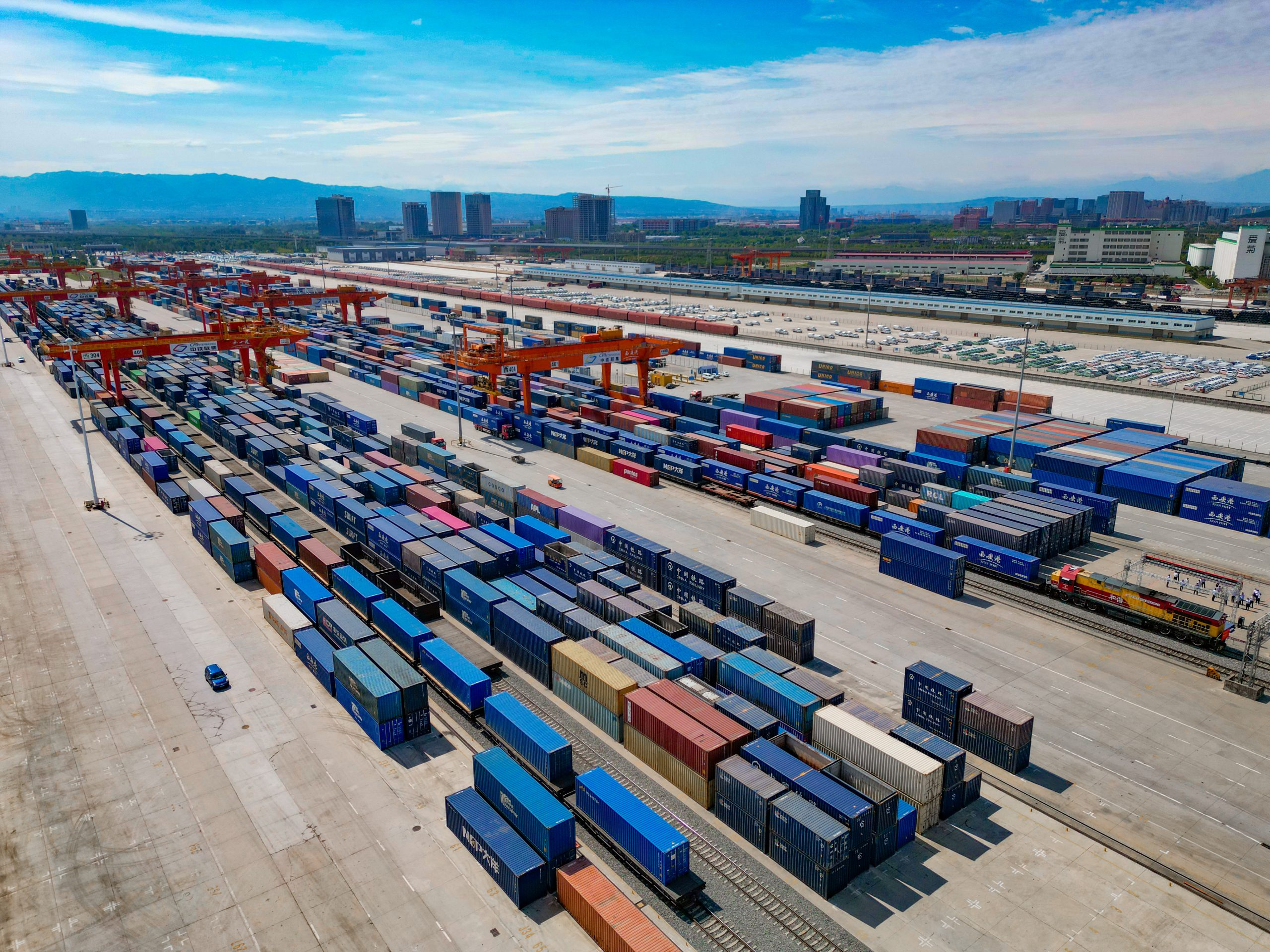
Your Container Changes Trains Twice on the Way to Europe
One product, three trains
A China-Europe rail booking behaves, commercially, like a single product. You book a slot, you get a container number, you get an estimated arrival. The container does not change hands in any way that shows up on your invoice.
Physically it is three trains. A standard-gauge train leaves China. Somewhere at the Kazakh border the boxes come off and go onto a broad-gauge train, which runs across the 1520 group. At the Polish border they come off again and go back onto standard gauge for the run into the EU.
Two transshipments, both structural, neither one an incident. And they are the two places where a rail schedule stops being a schedule — not because the change itself is slow, but because of what surrounds it.
Why the train has to stop at all
The reason is gauge. China and the main EU countries — Germany, Poland, France — run on 1435 mm. Russia, Kazakhstan, Belarus and the wider post-Soviet network run on 1520 mm. The two are close enough to look interchangeable on a drawing and incompatible in steel.
There is no rolling stock that solves this. A wagon built for one gauge cannot run on the other, so at some point the cargo has to leave one train and join another. Every route between China and Europe crosses that line twice, once in each direction of gauge.
Two crossings, and which one is yours
China to Kazakhstan — 1435 to 1520. This happens at Khorgos or Alashankou. Dostyk handles the same function on the Kazakh side. This is the first time your container is lifted.
Belarus to Poland — 1520 to 1435. This happens at Brest on the Belarusian side, with Małaszewicze on the Polish side as the EU’s principal terminal. This is most of the China-Europe traffic you have heard about, and it is the congested one.
Which crossing your booking uses is not a detail. Khorgos and Alashankou are not interchangeable, and neither are Brest and the alternatives. A rate built on one border is not comparable with a rate built on another.
Three ways to change gauge, only one of them matters for you
Container lift. A gantry crane takes the box off one train and puts it on another. The wagon chassis is untouched. This is what the trade calls the change-of-wagon method, and it is what essentially all China-Europe container traffic uses. A full train can be turned around in roughly 2 to 4 hours.
Bogie exchange. The entire bogie — the wheel assembly under the wagon — is swapped for one built to the other gauge. Faster, around 1 to 2 hours, but it needs the right bogies in stock and compatible chassis. Used on some Nordic flows, trialled on a few bespoke services, not the mainstream for China-Europe.
Wheel set exchange. The wheels themselves are changed. Cheaper on equipment, slower at 3 to 6 hours, and largely confined to certain eastern European crossings. Rarely seen on this corridor.
For a containerised shipper, the practical answer is the first one. The other two exist and are worth knowing about mainly so that a broker’s vocabulary does not confuse you.
The change is fast. The queue is not.
At Brest and Małaszewicze the sequence is straightforward: the broad-gauge train arrives, gantry cranes lift the boxes off and set them down briefly, then load them onto a standard-gauge train waiting on the other side. EU customs formalities are completed at Małaszewicze, though some services are pre-cleared at Brest in advance. Then the train goes on to Germany, the Netherlands, wherever it is going.
The whole thing is usually quoted at 4 to 12 hours depending on queueing and customs efficiency. Read that number carefully, because it contains the answer to a question buyers ask constantly.
When a rail shipment runs ten days late, the transshipment did not take ten days. The lift took hours. The variance lives in the queue outside the terminal, in the customs queue, and in whether a connecting train was there when the boxes came off. Quoting a fast transshipment time and treating it as the schedule is the single most common way buyers misread this corridor.
What it costs, and why it is already in your rate
Transshipment is a real cost line, not an administrative one: roughly 10 to 15 percent of total transport cost, according to industry reporting. You will almost never see it as a separate item, because it is carried inside the all-in rate — which is exactly why it is worth knowing it exists. When a rail rate moves and nobody can explain why, capacity at a terminal is one of the places to look.
The bottleneck is a piece of Polish ground
Brest and Małaszewicze are running close to saturation. That is not a temporary condition or a seasonal peak; it is the structural constraint of the corridor, and it is why a route that looks identical on two quotations can behave completely differently in a bad week.
Capacity is being added. On the Kazakh side, the Khorgos Eastern Gate dry port is intended to lift efficiency through the central Asian segment. On the Polish side, the Świdnik hub near Lublin is being developed to take pressure off Małaszewicze. Automated gantry cranes and digital tracking are being deployed to compress handling and customs time. All of it helps; none of it is finished.
There is also a routing answer. The Middle Corridor — Turkey, Azerbaijan, Georgia, across the Caspian — avoids the northern gauge crossing and, more to the point, avoids Russia. It is developing rather than mature, and it trades one set of constraints for another, but for some cargo it is now a genuine option rather than a diagram. If you are weighing it, our notes on Xi’an to Europe transit time are the place to start, because the corridor choice changes the arithmetic more than any terminal upgrade will.
And the direction of travel is worth noting: the stated aim of process optimisation on this corridor is to bring end-to-end time from 14 to 18 days down to 10 to 12. That is a target, not a timetable. Plan against the current range.
What we plan around
Five things, and the first one is the one people skip.
Assume two lifts, and put them in your landed-date calculation. Not as a delay, as a component. A schedule that treats the whole corridor as a single transit is a schedule with two blank fields in it.
Ask which crossing. Khorgos or Alashankou at the eastern end; Brest-Małaszewicze or an alternative at the western end. The answer changes both the rate and the risk.
Separate handling time from queue time. The lift is hours. The queue is the variable. When you are told a transit figure, ask what it assumes about the queue.
Treat terminal congestion as a live variable, not a fixed cost. It moves with season, with what else is queuing, and with developments on routes that feed the same terminals.
Keep a multimodal fallback in view. Where a rail leg is exposed to a saturated terminal, the alternative is rarely another rail product — it is a different mode or a different corridor. Multimodal transport planning is how that decision gets made before it is urgent, rather than during the week it becomes urgent.
Let’s talk about your route
If you are moving containers between China and Europe and want to know what your schedule is actually assuming, send us the origin, the destination and the crossing your booking uses. We will tell you where the two lifts sit in your timeline, which terminal is the constraint, and what the fallback looks like.
No commitment required. Just a conversation.
Email: [email protected]
WhatsApp: https://wa.me/message/QPR7JMHO3NFZE1
Based in: Xi’an International Trade & Logistics Park
Archer Sourcing helps European, Central Asian, and Middle Eastern businesses move cargo from China via the China-Europe Railway Express and overland corridors. We operate from Xi’an — the departure hub of the Chang’an rail service.
Handling times, cost shares and transit ranges quoted here are industry reference figures drawn from published material. They are not a rate, a quotation or a service commitment. Terminal capacity, customs practice and routing change; confirm the position at the time of booking.