
Alashankou and Khorgos: The Two Gates Every Westbound Train Uses
Your quote names a city. Your train crosses at a gate.
A booking confirmation for a westbound container normally tells you a departure terminal, a train number and an estimated departure. It rarely tells you where the train will leave China.
That matters more than it sounds, because every westbound train on the main corridor crosses at one of exactly two places: Alashankou or Khorgos. On the Kazakh side those are Dostyk and Altynkol. There is no third option today, and for most cargo there is no way around the crossing itself.
Between them, the two gates have carried more than 100,000 China-Europe and China-Central Asia trains over the past fifteen years, which is more than half of the national total. In 2022 the two together passed 10,000 trains; by 2025 that figure had reached more than 18,000. Whatever else changes in the market, this is the neck every westbound box goes through.
What a gate actually does
A rail border crossing is not a checkpoint in the sense a road haulier would recognise. Three things happen there, and only the first is obvious.
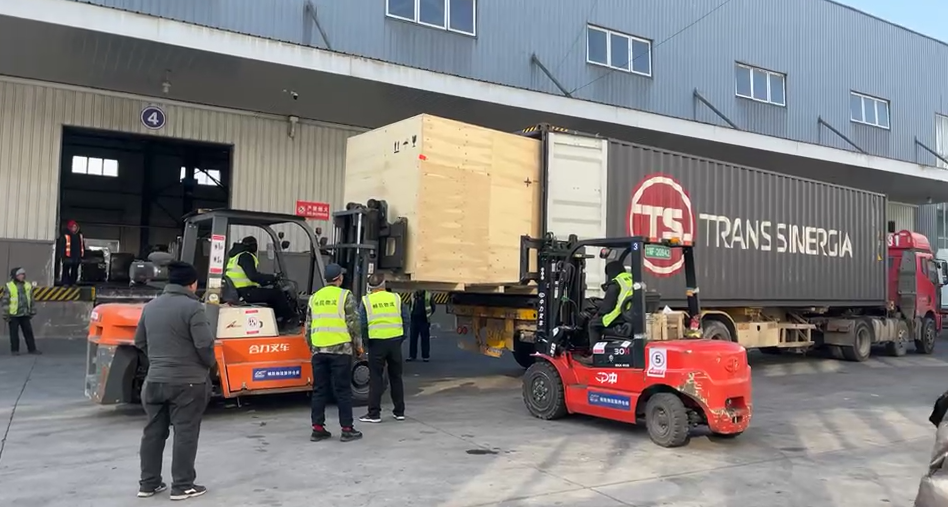
The gauge changes. Chinese rail is built to 1435 mm; the networks beyond the border are built to 1520 mm. Containers are lifted from one train to another, or the wagons are exchanged at a transloading terminal. That physical step is the reason rail schedules into Europe carry a variable nobody can quote with confidence at the booking stage, and we have written about the mechanics separately.
Customs and inspection happen. Export formalities close on the Chinese side; import formalities for the transit country open on the other.
The train is re-marshalled. Wagons are sorted into a new formation for the onward network. A train that arrived as a unit does not necessarily leave as one.
None of those steps is long on its own. What varies is the queue in front of them, and the queue is the part of your schedule that no forwarder can promise.
Both gates lead into the same country
Here is the assumption worth correcting. Buyers often assume the choice of gate is a choice of route — that one crossing means a northern path and the other a southern one, with materially different geography and different onward networks.
It is not that. Both gates enter Kazakhstan. Both feed the same onward network from there. The difference is the terminal: the layout of the transloading facility, how wagons are sorted, and which Kazakh yard your boxes are consolidated through before they join a train toward Europe.
Those differences are real and they do affect which service you can catch. But they are differences of configuration, not of map. A quote that implies one gate opens a fundamentally different route is overselling the distinction.
You do not choose the gate. The booking does.
This is the part buyers most often get wrong about their own leverage.
The gate is normally determined before you see a price. It follows the destination railhead, the service the operator is running that week, and where capacity has been allocated. If you are shipping to a Polish terminal, the train you are on is going to whichever gate that service uses — not whichever gate you would have preferred.
So asking “which gate is better” is the wrong question at the point of booking. The useful questions come earlier: which service am I actually on, where does it cross, and what has to be true for that crossing to hold its slot.
There is one genuine lever, and it is timing rather than selection. Capacity at the gates is finite and allocated. Book late and the allocation decides for you, which is how a shipment ends up on a crossing nobody discussed.
The part of your schedule the gate owns
Think of a westbound transit time as two different kinds of time.
There is work: the lift, the formalities, the re-marshalling. That is largely fixed, and it is the same work at either gate.
Then there is waiting: for a slot in the transloading queue, for a path on the onward network, for a wagon set to become available. That is the variable, and it is invisible in a quotation because it is not a rate. It shows up later, as a date that moved.
This is the honest reason we will not tell you that one gate is faster than the other. The answer depends on the month, the service and the direction, and anyone quoting a fixed advantage is quoting a memory.
Where the cargo gets assembled before it reaches a gate
The gates sit downstream of a decision made further back: where the cargo was consolidated.
Urumqi is the last marshalling point before the border and the first after it. It is one of the country’s five national assembly centres for the service, and a multimodal transport hub in the plain sense of the words — rail, road and container handling inside one fenced area. It has been operating a consolidation model that turns the city from a transit point into a gathering point, a model that was written into the State Council’s free trade zone reform pilots. The practical effect is that cargo which would otherwise move as loose less-than-container loads can be assembled into a full train there instead of waiting at origin.
That has a cost and a benefit, and they point in opposite directions. Assembling later means less waiting at origin for a container to fill. It also means your boxes join the queue at the gate later than they would have if everything had been consolidated at the coast.
The same city also runs land-sea combined transport, which lets cargo be loaded straight onto a vessel without the usual unloading and warehousing steps, and it is exploring the southern corridor and the China-Kyrgyzstan-Uzbekistan route as additions to the westward pattern.
The bypass that is not a lane yet
The China-Kyrgyzstan-Uzbekistan corridor is the one development that would genuinely change this picture, because it would be the first route west that does not enter Kazakhstan at all.
It is under exploration and development, not in service as a bookable product. We are not going to describe it as an alternative you can quote today, because it is not one. When it becomes one, it will not replace the two gates — it will sit beside them, and the interesting question will be which cargo it suits rather than which is faster.
The same caution applies to the southern corridor. Both exist as direction. Neither yet exists as a rate on a quotation.
It is worth separating two questions that get merged in these conversations: how cargo leaves China, and how it travels onward once it is past the border. The first is a two-gate question and will stay one for the foreseeable future. The second already has more than one answer, which is why China to Iran by rail works today on routings that have nothing to do with a new Chinese crossing.
What to ask when a quote names a city but not a gate
- Which service is this, and which gate does that service cross at?
- On the Kazakh side, which yard do the boxes pass through, and does that change the onward train?
- Is the crossing slot already allocated for this departure, or is it still to be assigned?
- If the queue at that gate lengthens, what happens to the delivery estimate — is it contractual or indicative?
- If this cargo could go through either gate, what would have to change for you to switch it?
- For Central Asia or Iran destinations, is a southern route being considered, or is this a Kazakhstan crossing by default?
The fourth question is the one that separates a schedule from a promise. A delivery date that survives a queue is a date somebody has thought about; one that does not is an arithmetic result.
Let’s talk about your actual routing
If you have a quote that names a departure city but not a border crossing, send it over. We will tell you which gate it is likely to use, what that means for the timing, and whether a different service would suit the cargo better.
No commitment required. Just a conversation.
Email: [email protected]
WhatsApp: https://wa.me/message/QPR7JMHO3NFZE1
Based in: Xi’an International Trade & Logistics Park
Archer Sourcing helps European, Central Asian, and Middle Eastern businesses move cargo from China via the China-Europe Railway Express and overland corridors. We operate from Xi’an — the departure hub of the Chang’an rail service.