
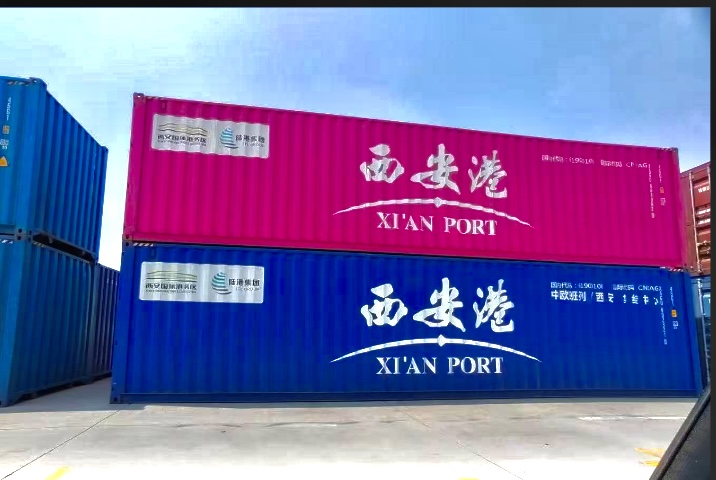
SOC vs COC: Who Should Own the Container on the China-Europe Railway Express
Two boxes look the same. They are not.
A carrier-owned container arrives with the booking. A shipper-owned container arrives because someone paid for it, and it will still exist as an asset long after the cargo has been sold.
On the China-Europe Railway Express, the second option is more common than most first-time shippers expect — and more misunderstood. We quote both. When a buyer asks which one is cheaper, the honest answer is that the question is wrong.
The real question is who is waiting for the box at the destination, and what happens to it after it is empty.
What the two terms actually mean at the terminal
COC means the operator supplies the container. The booking covers the box, the slot, and the empty repositioning that puts a box at your loading point. In return, the operator keeps control of that box: where it goes, when it comes back, and what happens if it does not.
SOC means the container is yours. It is bought or leased into your name, loaded at your factory or at a consolidation warehouse, and it leaves the country on the train carrying your cargo. Nobody at the other end is holding a booking against it.
That single difference — who is waiting for the box when it is empty — drives almost every cost and every disagreement in this decision.
What a carrier-owned box gives you, and where it stops
COC is the default for a reason. You do not finance equipment, you do not arrange empty positioning, and you do not need an entity abroad to receive a box back.
The limits appear at the end of the journey, not the beginning.
A carrier box comes with a free period. After it expires, the meter runs at the operator’s detention rate. The box also has to be returned to a nominated depot, which is usually the terminal yard or a depot the operator designates — not your customer’s warehouse gate.
Two consequences follow. The delivery appointment at destination has to be planned around the return leg, not just around the truck — which is exactly why the box decision shows up in Xi’an to Europe transit time planning, even though it looks like an equipment question. And a customs delay at destination is not free: the goods wait on the dock, and the box keeps charging while they wait.
We have watched cargo clear slowly while the box cost accumulated. That is a planning failure on our side of the table, not a carrier failure.
The compensation is that the equipment is not your asset. If an operator’s box is damaged in transit, you file a claim. You are not the owner of a damaged steel asset parked in a foreign depot with no buyer.
What you take on when the box is yours
SOC moves the equipment to your balance sheet, and in exchange you get control of the box after delivery.
You buy new, buy used, or lease one-way. The box is positioned to your loading point on your account. It must carry a valid CSC safety approval plate — this is not optional for international carriage, and a plate that has lapsed is a border problem, not a paperwork detail.
After the cargo is delivered, the box stays where you left it. That is the entire point, and it is also the entire risk.
Three things usually happen next:
- It gets loaded again with return cargo and travels back. This is the only scenario where SOC clearly pays for itself, and it requires a real backhaul, not a hope of one.
- It becomes storage. A steel warehouse on your customer’s yard, which is common when a buyer takes a full container and sells it down over several months.
- It is sold to a local buyer or to a leasing company, effectively folding the container into the price of the goods.
Each option needs someone on the ground abroad who can inspect, store or sell that box. This is the part buyers underestimate: an SOC box is only cheap if you already have a use for it at the destination.
And you insure it separately. Cargo insurance covers the goods inside the box. It does not cover the box. Repairs abroad are also a different market — workshop capacity and cost per repair vary widely by country, and a damaged box in a city with no container depot can sit for a long time waiting for a part.
The comparison that actually decides it
| Question | Carrier-owned (COC) | Shipper-owned (SOC) |
|---|---|---|
| Who supplies the box | The operator | You, bought or leased |
| Who pays empty positioning | The operator, inside the rate | You, as a separate cost |
| Free period and detention | Applies, at the operator’s rates | None — you own the clock |
| Where the box ends up | Returned to a nominated depot | Wherever you send it |
| Who insures the equipment | The operator | You |
| What you need abroad | A consignee who can take delivery | A consignee plus a plan for the box |
| Where it fits | One-way shipment, first order on a lane | Round-trip cargo, long dwell, unusual equipment |
Where SOC is the better call
You have real return cargo. If a European or Central Asian buyer is loading goods back toward China, and the box then continues by road or multimodal transport to the plant or the port, the container earns twice and the ownership decision becomes obvious.
The cargo will sit at destination. When goods are stored, sampled, repacked or sold in stages, an owned box turns a detention invoice into a storage asset you already paid for.
The equipment is unusual. Open-top, flat rack and other special equipment move in small pools. Securing them as SOC is often more reliable than competing for the operator’s limited stock.
You want the box to leave the freight cost sheet. Some buyers price the container into the landed cost of the goods and stop thinking about it. That is a legitimate accounting choice, as long as it is a deliberate one.
Where COC is the better call
The shipment is one-way. No backhaul, no overseas warehouse, no plan for the box — then owning it converts a clean freight line into an open-ended liability.
You cannot inspect or repair abroad. Without a partner who can look at the box, an SOC container is an asset you cannot see.
It is LCL. Consolidated cargo always moves in someone else’s box. There is no SOC option in a groupage booking, and any supplier who offers one is describing something else.
It is the first shipment on a new lane. Learn how the route behaves before you put equipment on it. Buying boxes to test a corridor is an expensive way to take notes.
The paperwork that decides it in practice
The commercial decision is easy compared with the documents that follow it.
- CSC plate and ACEP marking. Check the plate at loading, not at the border. An expired approval turns a commercial choice into a stranded container.
- Container condition at handover. Photograph the box inside and out, record the seal number, and keep the interchange record. For SOC, this record is your only defence against being charged for damage that existed before loading.
- Declare the box correctly on the booking. An SOC container must be declared as shipper-owned on the booking and reflected consistently in export documentation. A box that appears as carrier equipment in one document and as your property in another creates a customs question at the worst possible moment.
- Match the container number across documents. The number on the bill of lading, the packing list, the customs declaration and the loading sheet has to be the same box that physically leaves Xi’an. Container substitutions happen; the paperwork has to follow them.
- Insure the equipment separately for SOC. A cargo policy will not answer a question about a dented door.
Let’s Talk Before You Book the Box
If you are weighing SOC against COC on a specific shipment, send us the cargo, the destination and what happens to the box after delivery. We will tell you which structure we would use, what the empty positioning looks like, and where the detention risk actually sits.
No commitment required. Just a conversation.
Email: [email protected]
WhatsApp: https://wa.me/message/QPR7JMHO3NFZE1
Based in: Xi’an International Trade & Logistics Park
Archer Sourcing helps European, Central Asian, and Middle Eastern businesses move cargo from China via the China-Europe Railway Express and overland corridors. We operate from Xi’an — the departure hub of the Chang’an rail service.